Thursday, May 11

Big Brother's upgraded technology


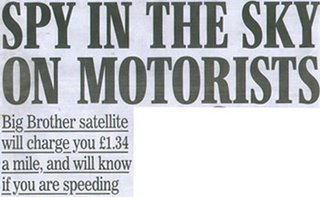
Bursting onto the front page of the Daily Express today is the banner headline (illustrated), "Spy in the sky on motorists" – the paper's "take" on the announcement by the newly appointed transport secretary, Douglas Alexander MP, that he intends to make satellite-based road pricing his "personal priority".
.
The Government's "big idea" for reducing road congestion is to impose a system of variable charging which could force motorists to pay up to £1.34 per mile at peak times, with lower charges – down to 2p per mile – on less frequented roads.
.
Predictably – and understandably – the paper picks up on the "big brother" aspect of the system, noting that the technology could be used to "snoop on the private lives of citizens" – a highly justified fear as the system itself relies on being able to record, very accurately, every journey you make in a car.
.
The technology to implement this latest big brother system will employ the GPS satellite navigation system and this will almost certainly be the EU's Galileo system.
.
The GPS system, in common with the US "Navstar" GPS system, is entirely passive, each satellite in the constellation simply transmitting a time signal. With three or more such signals, a vehicle-mounted receiver unit can translate these data into positional information and tell drives where they are.
.
Now for the sting, for a road pricing system to work the information is processed by what is called an "on board unit" (OBU) which holds personal and vehicle details in its microchip memory. It continually processes satellite signals to work out positioning, integrates those data with the personal details and then transmits that information via an in-built GMS mobile phone to a receiving station. There, the trip details are recorded and charges are calculated.Generally, the user will then then receive a monthly invoice, or cash can be withdrawn directly from users' bank accounts via a dircet debit.
.
To prevent "free riders", there will be a separate, but linked enforcement system. This involves, typically, road gantries with highly sophisticated cameras linked to number plate recognition software.
.
Given the huge number of private vehicles on British roads – approximately 25 million, and the extent of the roadnetwork, our dear Government is setting out to try something, the scale of which has never been attempted before.
.
The government track-record on major computer systems is lamentable and the sheer practicalities of getting the scheme up and running are daunting.
.
In order to get public agreement, the Government will no doubt attempt to sugar the pill by promising to lower petrol tax. But, according to the Express, fewer than one percent of drivers actually believe the government would do this. The charges would be yet another tax on motorists. Combine that with the "civil liberties" issue of all journey data being recorded and public hostility is almost guaranteed.

Wednesday, May 10

Dr Who - Loan to Labour Party


Doctor Who reigned supreme at the Bafta’s TV Awards in London on Monday. The BBC drama series won three awards; Best Drama Series, Pioneer Audience Award and the Dennis Potter Award for outstanding TV writing.
.
.
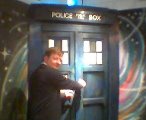
Above, Peter Troy - a regenerated Dr Who of the future ?
.
Well hold on to your sonic screwdrives dear fans of the Doctor a scandle is afoot. An article in Private Eye claims that Dr Who was only created a Time Lord after making a loan to the Labour Party.
.
According to the Eye a disgruntled Dalek has spilt the beans saying: ''Dr Who lent the Prime Minister his Tardis so that Tony could go back in time and regenerate himself by turning himself into Mrs Thatcher.''
.
A spokesman for the Time Lord issued a statement saying ''the details of the loan are unavailable since it was all a very long time in the future.''

Tuesday, May 9

World Trade !


Venezuela, the world's fifth-largest oil exporter, has struck a $2bn deal to buy about 100,000 barrels a day of crude oil from Russia for its own use until the end of the year.
.
Amazingly, Venezuela has been recently been forced to turn to an outside source to avoid defaulting on contracts with "clients" and "third parties" as it faces a shortfall in production. Venezuela could incur penalties if it fails to meet its supply contracts.

The relevant question is how much fuel and environmental damage is being done shipping fuel halfway across the world to a country that produces vast amounts of the product to the international market yet can not for some strange reason retain any for its own use.

As they used to say 'up North' (in England) - ''it's like sending coals to Newcastle''. Well actually coal is now shipped to Newcastle from Argentina or is it beef ? Anyway, it is the same point since there is a supply of both in the North East; though the latter is now more visible than the former.

Sunday, May 7

The Sunday Quote


''A politician is a person skilled in the art of compromise. Usually an elected official who has compromised to get nominated, compromised to get elected and compromised repeatedly to stay in office.''

Dick Gregory, US Civil rights activist. 1932 -

Prescott's lost briefs


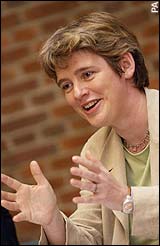
Above Rt Hon Ruth Kelly
who takes over John Prescott's briefs.
.
With all the results now in from the local elections on Thursday, Conservatives have gained 316 seats, now holding 1830, Labour are down 319 to 1439 and the Lib-Dims have gained two bringing them to 909.
.
Labour lost control of 19 councils including some key boroughs in London and the Tories gained 11, including Hammersmith and Fulham, which they have not held since 1968. The Lib-Dims gained one.
.
The weakness in the Tory result is that there is no "breakthrough" in northern cities. They failed to win any seats in Manchester, Liverpool or Newcastle. In Bradford, Labour actually increased its number of seats from 30 to 36, at the expense of the Tories who went down from 35 to 33, making Labour the largest party.
.
If the polls had been held nationwide, the Tories would have gained 40 percent of the vote, Lib-Dims 27 and Labour 26 percent. Turnout is estimated at 36 percent - down three points from 2004. Despite this, we have had Francis Maude, Chairman of the Conservative Party, leering from the TV, crowing that people had made a "positive statement" about "modern compassionate Conservatism". An amazing statement from a man who is just about as compassionate as a snake looking at its next meal.
.
Cameron himself, is feeling "very positive", saying his party had now broadened its appeal and was "on its way back". To where exactly he did not allude, but then he never does.
.
The Lib-Dims have done poorly, gaining hardly any seats. Sir Ming has invented a new word for failure: "consolidation" - although his Party has knocked the Tories off their perch in Harrogate. They are, however, making much of having moved to second position in their share of the vote - by one percent.
.
BNP have got 11 seats (out of a possible 13) in Barking. They say it's a revolt against the entire liberal political establishment. They're probably, regrettably, right. Dewsbury in Kirklees looks interesting. BNP gain two, bringing their local representation to three. After some losses, and total gains of 27, they now hold 32 seats.The Respect party gained 11 seats in Tower Hamlets bringing their overall total as a party to 13. UKIP gained one councillor, at Hartlepool, despite predicting nationwide gains of 20. The Greens did get 20 seats, bringing their total to 29.
.
Chris Davies leader of the Lib-Dim MEP group has been forced to resign over offensive remarks in an e-mail to a Jewish constituent. And they have the nerve to condemn the BNP for being "extreme"?
.
Meanwhile, the election results have been somewhat eclipsed by Blair's "biggest ever" reshuffle. Charles Clarke, the Home Secretary, is toast! Despite being offered other jobs, he has been sacked and has left the government to return to the back benches. He is replaced by Dr John Reid - one to watch as a possible heir to the Blair throne. Des Browne takes over Defence.
.
Jack Straw goes, demoted to Leader of the House. He is replaced by Margaret Beckett - promoted after her catastrophic failure on single farm payments. Hoon is moved back into Cabinet to take the post of Secretary of State for Europe.
.
The "Europe Minister" is now Cabinet rank (although there is some confusion about this). If this is the case, the post of Foreign Secretary has effectively been split into two - Europe and
the rest of the world. One wonders whether the Conservatives will reciprocate with a 'shadow'. David Milliband, incidentally, takes over DEFRA.
.
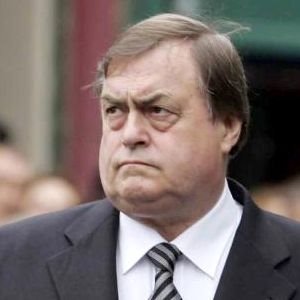
Prescott has kept his title of Deputy Prime Minister with his Cabinet salary and grace-and-favour residences - and his government Jag. He is, however, stripped of departmental responsibilities, or as the BBC reported ''Prescott loses his briefs''. Prescott's departmental responsibilities are taken over by Ruth Kelly - at least she will not have any "problems" with her diary secretary. Alan Johnson takes over the Department for Education.
.
Alistair Darling moves from the joint post of Transport and Scotland Secretary to take Trade Secretary, while Douglas Alexander takes his post as Transport Secretary and takes on the additional role of Secretary of State for Scotland.The election results were a "warning shot" for the government, says Gordon Brown.
.
On the other hand, Hazel Blears, who becomes "chair" of the Labour Party, believes the message from the elections is that "people want us to press on ... do more, go further".
.
One wnders what is written on Ms Blear's briefs !
.
.
.

Tuesday, May 2

Troy's (long) briefs - ' Long Johns'


Troy's briefs are back.
.
Regionalisation Prescott's Dream


with thanks to Dr Richard North


,
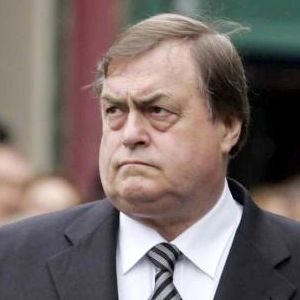


John Prescott - Regionalisation

There is a much more powerful reason, other than his recently announced affair, why the Deputy Prime Minister, John Prescott (formaly two Jags now two Shags) should be removed from office as soon as possible.

For, although he is widely regarded as a buffoon, it is largely this man who, almost single-handedly, has put the EU-related regionalisation programme on the Labour Party’s agenda, and kept it there despite the wishes of many - including Tony Blair.

An explanation and short history:

The Labour Party had endorsed the concept of Regionalisation in 1995 then it backed off from its own proposals to established fully-fledged regions with their own elected assemblies.
.
Instead, it settled for indirectly elected regional chambers (later the name was changed to Regional Assemblies) which would not compete with local government.
.
A similar approach was adopted in a 1996 Labour policy document entitled: "A New Voice for England's Regions", and in the 1997 manifesto. Both documents made it clear that, where there were calls for the creation of regional assemblies, popular approval would first have to be demonstrated in regional referendums.
.
Prescott established a "Regional Policy Commission" This recommended that each region should have a Regional Development Agency (RDA) "to promote economic development in the region with an accountable and strategic regional framework".
.
Such was the power of Prescott that he managed to put on the Party’s manifesto a reference to RDAs and, in the Queen's Speech of 14 May 1997, the newly elected Labour government, under Tony Blair, announced its intention to create them. The RDAs themselves, were to be Prescott's "Trojan horse" – embryonic organisations which would, in the fullness of time blossom out into full-blown regional governments.
.
However, the Labour Party remained lukewarm on further regionalisation, and there were indications of tension between Blair and Prescott on the issue. For instance, in July 1999, the EU commission was proposing to cut the assisted areas in the UK, from covering 34 percent of Britain's population to 29 percent. Prescott was reported as seeing that the "obvious answer" to the cuts was to press on with "the next stage of devolution" - setting up elected assemblies in the eight English regions outside London.The same report observed that this was "far from obvious" to Blair, who was held to believe firmly that central government should only move in this direction when there was a clear demand coming from the regions.
.
As a further indication of where Prescott stood, the report continued:''Nevertheless, some regional politicians want to move a bit faster. Last week, the North-West Regional Assembly, which is the unelected supervisory body for the regional development agency, agreed to set up a "constitutional convention" chaired by the Bishop of Liverpool, to work out a plan for an elected assembly. A similar body has already been set up in the north-east. All of this activity is being enthusiastically egged on by Mr Prescott.''

By January 2001, however – with talk of election in the air – "insiders" were noting the emergence of a Prescott-Brown axis in support of regionalisation. The chancellor had promised that a second-term Labour government would strive to create a "Britain of nations and regions" as part of its bid to secure an economic renaissance outside the prosperous south of England.
.
Brown then suggested a new package of regional policies could be unveiled in the manifesto, or shortly after the election, hinting that this might include a commitment to directly elected regional government. "As we develop regional policies that are locally generated and managed, there has to be local and regional accountability too", he told a conference at the University of Manchester Science and Technology Institute.
.
Members of the pro-devolution Campaign for the English Regions had welcomed the Chancellor's comments, suggesting they were the result of an alliance between Brown and Prescott, "who is strongly in favour of regional government".
.
Prescott's aides had also been "raising the stakes in the internal battle to commit the party to a strong regional dimension in its forthcoming manifesto". Late the previous year Richard Caborn, the trade minister and a close friend of Mr Prescott, had told a Fabian Society meeting in York: "I believe the radical programme of constitutional change we embarked on in 1997 is incomplete without an answer to the so-called English question. Regions need a clear voice to promote economic development and that in my view is best achieved through (elected) regional assemblies".
.
Prescott seemed to have got his way in March 2001. Blair, "known to be cool on further devolution in the wake of the creation of the Scottish and Welsh parliaments" told business leaders in Cardiff that the government was ready to go further. But only with the consent of people living in the regions. This was regarded as a "massive boost" to regional campaigners.
.
Two weeks earlier, Prescott had promised delegates at Labour's spring conference a green paper on regional government.Despite this, when the Labour Party issued its manifesto just before the June election, it was content merely to "strengthen regional economies with venture capital funds and new powers for reformed Regional Development Agencies". And its promise to make provision for directly elected government in the regions was vague, hedged with the referendum caveat and the condition that "predominantly unitary local government" had to be established.
.
The tension between Blair and Prescott continued when there was no reference to English regions in the Queen's speech announcing the newly elected Labour government's legislative programme. This brought an intervention from Europhile Peter Mandelson, former Northern Ireland secretary and then "self-appointed champion of the regions". He warned that unless Westminster shed more power to the regions it would risk a two-tier England that was "dangerously unbalanced".
.
The pressure succeeded. At the earliest possible opportunity after the election, with the manifesto condition for "unitary authorities" far from satisfied, Prescott pushed out not a green but a white paper. Never mind that, with his co-author, Stephen Byers, he was besieged by the problems of Railtrack and an almost complete breakdown in the rail system. Clearly, for Mr Prescott, elected regions were more important – even to the extent of confronting his own prime minister
.
But then, Mr Prescott, born in 1938, is no ordinary politician. Best known for his garbled syntax, behind the façade of an amiable – and sometimes not so amiable – blunderer, lies a man with an iron will.
.
As a 17-year-old merchant seaman, he fought a bitter battle for the National Union of Seamen in a lengthy strike which led to its leadership – including Mr Prescott – being described by Harold Wilson as a "tightly knit group of politically motivated men". He joined the Labour Party in 1956, was parliamentary election agent for Chester in 1964 and stood as a Labour candidate for Southport in 1966. Four years later, he was elected to his present constituency, Kingston upon Hull East.
.
There is also a considerable "European" dimension to Mr Prescott’s career. In 1973, he became a delegate to the Council of Europe, where he spent two years, emerging as leader of the British Labour group. He then joined the European Parliament in 1975. That was at the height of Labour's referendum campaign for continued membership of the "Common Market" and just as the nascent regional policy was emerging in the EEC, with the launch of the ERDF. And so strong were his "European" credentials that he was offered, but declined, the position of EU commissioner.
.
Thus, Prescott's introduction to European politics came some thirty years ago. From his own mouth, he dates his enthusiasm for regional policy "…back more than 30 years". Therefore, either shortly before or, given some latitude for an "approximate" 30 years, during his tenure as a UK delegate to the Council of Europe, Mr Prescott became a convert to regionalism.
.
It seems hard to believe that his thinking was not influenced by ideas then current in the Council, or subsequently while he was in the European Parliament.
.
Not long after his return from "Europe" in 1981, undoubtedly still imbued with enthusiasm for regional policy, Prescott became Labour's regional affairs and devolution spokesman, under Michael Foot, who asked him to draw up a new policy framework to secure agreement for devolution for Scotland, Wales and the English regions. The result was a publication: "Alternative Regional Strategy: a framework for discussion", which set out plans for devolving power to Scotland and Wales and, predictably, the creation of English regions. To these objectives, Prescott, with his background in European politics, would remain constant.
.
Crucially, in 1989, Prescott was elected to the Labour Party's ruling body, the National Executive Council (NEC). Also on the NEC was another ardent regionalist, Sir Jeremy Beecham, then Labour leader of Newcastle upon Tyne City Council.
.
Having served on the NEC's Local and Regional Government sub-committee, Beecham was also Vice Chairman of the Northern Regional Councils Association. He was Chairman of the Local Government Association (LGA), was leader of its Labour Group, and was to become Chairman of the Association of Metropolitan Authorities. He was made President of the British Urban Regeneration Association (BURA) in 1995 and served as a member of the President of the Board of Trade's Working Party on Competitiveness. From 1987 to 1996, he worked with the Joseph Rowntree Memorial Trust, an organisation that generously funds the Campaign for English Regions and which financed much of the Scottish Constitutional Convention that pressured for Scottish devolution.
.
Apart from their positions on the NEC, Prescott and Beecham would have had ample reason for meeting frequently and indeed they did, not least when Prescott in July 1997 – shortly after Labour came to power - invited Beecham to work in a joint venture called the "The Central-Local Partnership". This had been set up by the government and the LGA as "a forum for central and local government to work together to tackle the multiple causes of social and economic decline, and to improve local services".
.
Together, the Prescott-Beecham partnership has worked quietly and steadily to pave the way for regionalisation – often on arcane initiatives such as the “reform” of local government finance which would allow local authorities to take out capital loans without first having to seek central government approval.
.
This would enable regional authorities to approach the EIB for loans without needing to refer to the government.But the vital element of the relationship was the route into the LGA through Beecham's chairmanship. This was important because the LGA's sister organisation, with which it shares an office in Brussels, is the Local Government International Bureau (LGIB). It serves as its European and international arm and, in particular, acts as the UK member of the Council of European Municipalities and Regions - one of the main driving forces behind regionalisation in Europe.In England, the LGA – with Beecham at is head – is the driver of regionalisation, co-ordinating a plethora of allied associations, including the ERN, all moving towards the same end.
.
The role of these "allied associations" was noted by a University of Wales researcher who concluded that bottom up "local authority regionalism" had emerged in the 1990s through them.
.
Funded by constituent authorities and composed of nominated members and seconded officers, these associations, he asserted, were working to create agreed policy on economic development, transport and land use questions and EU structural funds policy.Small wonder that when Prescott published his White Paper, his co-enthusiast, Sir Jeremy, responded positively: "The LGA is keen to ensure that regional assemblies have the backing of local people and that the process for establishing them does not divert councils from improving their services to local people. Regional assemblies should embody a genuine devolution of power from Whitehall".
.
Unlike thousands of councillors, a hostile media and an unenthusiastic public, he had no qualms whatsoever about the idea. It was, in typical Prescott style, a matter of how, not whether.
.
In the North East serious persuasion (under the direct supervision of Prescott) of the business community was undertaken in the eighteen months prior to the elected regional assembly election. Prescott was determined that the business organisations in the north east were brought 'on side' without delay.
.
Despite the rejection of the ideal by the overwhelming "no" vote in the North-East region (78 per cent against) the agenda continues to this day, pushed by Prescott, imbued with his thirty-year-old enthusiasm, engendered by his work in the Council of Europe and supported amazingly by the Federation of Small Businesses and the Chamber of Commerce.
.
Not many Labour MP's on the benches, in private, now seem to show as much enthusiasm for regionalisation and, should Prescot depart, there is some hope (not least from Blair) that the regionalisation project will be quietly dropped from the governments agenda.


j j j

Notes: from the editor's diary.

The 'double devolution' plans recently devised by David Milliband are not about devolution they are, in actuality, firmly about centralisation. To state that: ''central government lets go of central control'' (John Wright May/June North East Regional Voice) is to accept at face value what the government is saying and to fundamentally misunderstand the true nature of what is being proposed.

It is like some other forms of doubling. Such as double negatives, and double think. Not really about devolution and localisation --more about centralisation of government but with an extra layer of spin. An elaboration of the detail on this point on this issue is available upon request.
.
In the summer of 2003 when Tony Blair was invited to address a meeting of the Labour Party organised and funded North East Business Forum. At that meeting I asked the Prime Minister a question concerning the level of his personel support for regionalisation. The PM's surprisingly frank reply that ''others in the Cabinet are more enthusiastic of regionalision that I am'' is evidence of the extent that Prescot had pushed his project against the wishes of his Labour Party Cabinet colleagues.

The Federation of Small Businesses (FSB) in 1998 established Regional Policy Units, primarily aimed at maintaining a watching brief on the then new RDA's. I recall, with some bemusement, when the newly formed OneNorthEast produced the first of their many consultation papers which I noted omitted to any reference to contact details.

I was persuaded, very much against my better judgement, not to make an adverse comment either in the press or directly on how that ommision reflected badly in the actuality of the new Quango's real interest in receiving comments. The philosophy of ''don't upset'' and ''moving forward'' with the Orwellian OneNorthEast curiously continues to this day as the an intrigal part of the partnership arangements with the RDA.

Sunday, April 30

The Sunday Quote -

''The big print giveth and the fine print taketh away''

J Fulton Sheen (1895-1979)

Sunday, April 23

The green man

David Cmeron communing with his melting glacier
.
"If I read another word about climate change, I shall go mad," writes Edward Celiz of Bodham Halt, Norfolk in today's Sunday Telegraph letters. in so doing, he echoes precisely the sentiment of this blog.
.
If the Boy King (The Rt Hon David Cameron, MP Leader of Her Majesty's offocial and loyal opposition) ) mentions his 'green revolution', once more, we on this blog will all scream.
.
"Edward Celiz's letter is preceded by one of slightly more weight, written as it is by 41 scientists who, according to the heading, "debunk global warming alert". All of them eminent in the climate field, they venture the opinion that "global climate changes all the time due to natural causes and the human impact still remains impossible to distinguish from this natural 'noise'". They also note that "observational evidence does not support today's computer climate models, so there is little reason to trust model predictions of the future".
.
For anyone who cares to explore the subject, there is no end of sources that will confirm that view, the sum of which affirm that, far from being consensus, or the issue being fixed, the arguments over global warming are far from resolved and the issues are, in fact, highly contentious.
.
In one positive development in an otherwise bleak landscape, Booker has been pulled out of semi-obscurity in the inside back page of the Sunday Telegraph, where we was consigned by the erstwhile, unlamented editor Sarah Sands.
.
Mr Booker has been returned to his former glory by the new editor, Patience Wheatcroft, in what we hope will now be the start of the paper's reversion to a proper newspaper.
.
In his column (which is essential reading for all attendees at the Bruges Group meeting on Tuesday evening) charts the damage John Prescott has done to British democracy, and also points up Defra's latest gaffe – a hilarious reporting error.
.
A story in The Times yesterday, which reported the Boy King in trouble over his choice of car. No sooner was he back from Norway in his gas-guzzling private jet, having communed with his melting glacier, than the Greens were protesting that he had failed to pick the most environmentally-friendly option for his next chauffeur-driven car - to be provided at the taxpayers' expense, on top of the Boy's £125,000 salary.
.
The Greens wanted Cameron to take a petrol-electric hybrid Toyota Prius but, instead, the leader of the opposition opted for a Lexus GS 450h.
.
Cameron is going to regret he ever opened this can of worms.However, that has not stopped him prattling away in a vacuous opinion piece in the Sunday Telegraph, the centrepiece of which is his "radical agenda for greener cars" which he is to announce tomorrow.
.
Cameron wants – or so he tells us – "Britain to be at the forefront of international efforts to build a new generation of motor vehicles that are much less environmentally damaging." Such a programme, he adds, "will include significant incentives to encourage the ownership of newer, greener vehicles."Unsurprisingly, these "international efforts" are remarkably similar to those set out by the EU last year, which rather proves ours and Booker's point. The Boy King has simply bought into the EU "green agenda" and, what is worse, he is now trying to pass it off as an expression of "traditional Conservative values".

Friday, April 21

Happy Brirthday Ma'am


A very Happy Birthday to Her Majesty Queen Elizabeth II
on the occasion of her 80th Birthday

Thursday, April 6

Cameron's gaffe

The Blog Editor, Peter Troy who as a former UKIP candidate awaits David Cameron's apology, above pictured in Scotland during the 2004 European Parlimament Elections.
.
l
.
As fruitcake recipes are suddenly in vogue in certain offices in Brussels, the unsavoury joke doing the rounds at the moment, following the Boy King's (David Cameron) incredible UKIP gaffe yesterday, is that the next election-winning stunt planned by the Tories is to recruit a cadre of experienced suicide bombers to blow up central office.
.
That at least would give tangible form to what effectively amounts to the slow electoral suicide being committed by the Conservative party as it insults the very voters it needs if it is to win at the next contest.
.
That the Boy King's experiment in "modern compassionate conservatism" is failing is borne out by the latest Times Populus survey, taken over the weekend. It suggests that despite the Labour Party being in almost complete meltdown, its support is holding up in the polls, up one point since early March to 36 percent, while the not-the-conservative-party is down one point at 34 percent.
.
When even the Telegraph turns against Cameron, you know he is in trouble. Its leader is headed, "UKIP deserves better", declaring that "if the Conservatives have a strategy to denigrate UKIP, in the hope of halting the erosion of their own vote, they should remember Michael Howard's blunder before the 2004 European elections."
.
It was then that he called UKIP leaders "cranks and gadflies", whence their vote climbed appreciably. Given the commendable cussedness of the British, Mr Cameron's suggestion that party members are "fruitcakes, loonies and closet racists" will almost certainly have the same effect.
.
Commenting on the sincerely-held beliefs of UKIP supporters, the leader then concludes that "it is precisely this sneering indifference to people's passionate concerns that makes them so fed up with politics," adding that "the Tory leader should apologise."
.
Of course, the Boy King will not apologise. What he said yesterday he holds to be self-evidently true and, if he runs to form, his view will be that, once again, the people – and the Telegraph – have failed to recognise this truth. That is their fault, not his.
.
It is not so much, the "sneering indifference" that is the Boy King's problem, therefore. It is that he inhabits so different a planet from the rest of us that he cannot even begin to understand that he has made a mistake
.
Such is his mindset that there should be a good job waiting for him in the EU commission, when his despairing colleagues finally throw him out. The only question now is whether that will be before or after the Conservatives lose the general election.

Monday, April 3

The chicken and the egg


State funding widens the gap between government and governed writes Daniel Hannan in The Telegraph today, in a cogent piece that argues that taxpayers’ cash will guarantee more party sleaze.
.
To develop his thesis, he points to experience in Europe, where state funding is the norm and has neither bridged the divide between the ruling classes and the people nor cleaned up what Hannan rates as "the dirtiest political systems".
.
Good as his piece is, however, what Hannan doesn't do is suggest an alternative to state funding, or even offer an analysis of why the political parties in this country have got themselves in such a mess over financing their activities.
.
Arguably, though, the way out is the more important issue for, if the voters rebel at the thought of doshing out their hard-earned cash to keep the political classes in the luxury they palpably do not deserve, then alternative means of funding have to be found.
.
Oddly enough, the answer is already there, in the Conservatives' own supposed manifesto, in which they laud the merits of localism. If they look to their own past, they will see that the formidable strength of the Tory electoral fighting machine was in its local constituency associations, which could collect money and turn out the troops to bring in the votes.
.
But, as with politics in general, over the years we have seen massive centralisation in political parties, with elections and fund-raising being managed from central office, with the local associations being relegated to a bit-part role and the views and skills of local campaigners being largely ignored.
.
To a very great extent, "Europe" – as they insist on calling the European Union – has played a great part in this. The constituencies are largely Eurosceptic, at odds with their own party hierarchy, to the extent that there are two Conservative parties, inhabiting entirely different planets.
.
To rely on the constituencies and their funding means getting in touch with your grass roots, asking what people think, listening to them and then acting on what they say. In other words, the political classes have to respond to their own local parties, instead of running their own agendas.And it is this that the central office control freaks find so difficult to do. For them who want to dictate rather then respond, such reliance is an anathema. It is much easier, therefore, to tap up a few rich men and corporate sources, to enable them to run their own campaigns, sucking up to the Westminster media village (who are just as out of touch as the politicos) and laying down the law to the locals.
.
Combine that with the inherent and almost insufferable arrogance of that group of people collectively known as "Tory boys", who labour (if I can use that word) under the impression that they have any value to society at all, and who insulate themselves so successfully from the real world that they feel the need to talk only to themselves, and you have a self-referential society that has lost the art of listening and responding.
.
Thus, although we can take it from Hannan that state funding would widen the gap between government and governed, the real problem is that that gap already exists – it has already been created by the party machines and the current funding crisis is a symptom rather than a cause of the problem.
.
Within that framework, all state funding would actually do is cement in the evils that already exist – the chicken that was there long before the egg.
.
If the parties do seriously want to narrow the gap, then they have to revert to their own local associations, and rely on ordinary party activists to take up the slack. But, as that means listening to people and responding to them, that is unlikely to happen.

Sunday, April 2

A dispatch from the bunker

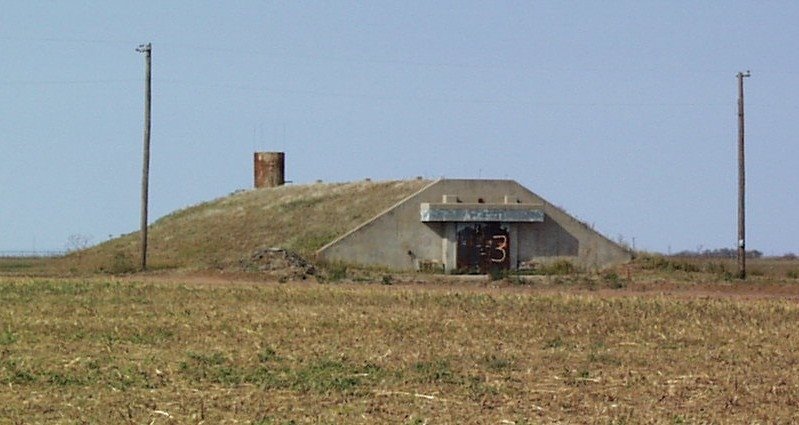
Above, a Royal Obserever Corps Post Bunker - Huntingdon, Derbyshire. One of 1563 bunkers that were a part of the UK nuclear attack monitoring defence system of which the Editor of the blog was a serving member during the latter stages of the Cold War .

.

.

Obervational dispatch


by Dr Richard North
.
Things have come to a pretty pass when I actually agree with Simon Jenkins, but his piece today in the Sunday Times, headed "Desperate dispatches from the banana republic of Great Britain" is right on the button.
.
He starts by recording the disastrous collapse of the single farm payment scheme, leaving England's 120,000 farmers begging for their subsidies. He then notes that although Margaret Beckett, Defra’s secretary of state had declared: "I take full responsibility," all she actually meant was that she had just sacked one of her officials, Johnston McNeill, so as to save the skin of her farm minister, an obscure Tony crony called Lord Bach. The latter had spent six months deriding critics of his scheme as "shoddy" and creating "unfounded alarm and uncertainty".
.
The shambles at Defra, writes Jenkins, might win more publicity were a similar litany of woe not rising from every corner of Whitehall. He then goes on to record but a mere fraction of them which put together, speak of a nation, the administration of which is falling apart at the seams.
.
Booker picks up on the single farm payments shambles, in the limited space afforded him, calling it "easily the worst administrative fiasco the government has created in farming since the foot and mouth epidemic in 2001", and notes that it is in part due to "the unique complexities of the system devised for England by Margaret Beckett, and the collapse of the computer system devised by Accenture (the same company that is responsible for the chaos engulfing a £6 billion computer system for the NHS)."He also notes that, while Johnston McNeill, as head of the Rural Payments Agency (RPA) has been suspended, he continues to draw his £160,000 a year salary.
.
Failure, it seems, is no bar to prosperity when you are in Blair’s public service. Jenkins notes that part of the trouble with the NHS is Hewitt’s extraordinary decision to proceed with Accenture’s £6 billion “choose-and-book” computer. This is an unnecessary machine, he writes, for which no health professional ever asked and which was sold to her predecessors by the smooth-talking salesmen now beating a path to the softest touch in global computer procurement, the British taxpayer.
.
A leaked report in February suggested that the NHS computer may end up costing a mind-numbing £ 50 billion.The Sunday Times business section cites one public procurement expert saying the scheme had been "cretinously and ineptly procured… the reality is that the original deal was hammered through with very little real understanding of the consequences on either side. Some of the participants had no idea what they were taking on."
.
Yet, as The Business reports, Accenture is now to bid for the contract to provide biometric technology for the UK's identity registry, which will underpin the government's identity card scheme.That, in a way is good news. If its efforts are at least as good as its work RPA and the NHS, Accenture will ensure that the identity card scheme will never actually function, but the one certainty is that even the LSE’s pessimistic forecast of £18 billion for the cost of the scheme will be a gross underestimate. Jenkins records that the cost is escalating past £12 billion towards, on one estimate, £30 billion.This is not public administration but public chaos Jenkins adds despairingly, but it is not only the administration which is going to wrack and ruin.
.
Henry Porter in The Observer sets out the savage damage done to the constitution by New Labour, echoing a theme we have raised in this blog, with a call for a Bill of Rights. Porter’s thesis is that Labour's programme of legislation challenges the British constitution like no other administration before it.
.
In a thousand tiny - and not so tiny - cuts Labour threatens our rights and freedoms, the rule of law and the sovereignty of Parliament. For the past two weeks he has been going through all the Labour legislation that has reduced our freedoms, compromised our rights and menaced the life of Parliament. He found it an extremely depressing experience, not least because he has now discovered that parliament – "your and my elected representatives" - has been sidelined. Welcome to the world, Porter.
.
From the sublime to the ridiculous, though, Jeremy Clarkson takes us to his world, a world infested with speed cameras, the increase in numbers of which, he shows, exactly matches the slackening off in the rate of decline in road deaths. Commenting on those who have fallen foul of the reign of Gatso, he observes that he’s be willing to bet they'd trade Tony Blair's idea of a nation state for anything. Even the EU.
.
We cannot agree, as things are hardly better there. For instance, The Business records in depth the total Horlicks that Peter Mandelson is making of EU trade policy while Allister Heath asks: "Is France ungovernable".
.
However, Clarkson does have a point. Excuse me while I retreat to my bunker.

Sunday, March 26

The 150 th Sunday Qoute

Our 150 th offereing today is:


''Political language - and with variations this is true of all political parties, from Conservatives to Anarchists - is designed to make lies sound truthful and murder respectable and to give an appearance of solidity to pure wind.''

George Orwell (Eric Blair) 1903 - 1950
.
Note - The Sunday Quote has been published since 2003 on various websites and discussion forums. Recently The Sunday Quote received the ultimat accolade from a political commentator, that of being quoted.

Changing times


Well it is cold, windy wet and downright miserable in our green and (mostly) pleasant land. At 1 am (01.00 hrs GMT) British Summer Time (BST} began and the clocks in the Realm were advance one hour.

In a bid to boost the nations moral (and perhaps improve the weather) a three year trial of double summertime (last introduced during the Second World War) was introduced by Lord Tanlaw, a 'crossbencher'. Under Lord Tanlaw's Bill the clocks would not go back an hour in October but stay an hour ahead until next March. An other hour would then be added until the following October.The change would make the most of daylight hours by providing an extra hour of evening daylight throughout the year.

Lord Tanlaw said that the most compelling case for change was that the potential to save 100 lives on the UK's roads each year. He added that other pros included ''a deterrent to early evening crime and gaining £1bn a year in tourist revenue.''

The Bill received enthusiastic cross-party backing, but Lord Sainsbury a government minister and substantial donor to the Labour Party would not support the plans. The Bill did gain an unopposed second reading but without Government backing it has no chances of becoming law. A consideration of course is that if the UK were to be an extra hour a head of our European ''partners'' that would put the clocks back on the process of further integration into the European Union.

Friday, March 24

Thanks be to our soldiers


When British, American and other coalition soldiers risk their lives to save one British and three Canadian peace campaigners (pictured above) from terrorists who had kidnapped them. Then it becomes “release”. Or so it seems from the various comments on the BBC Website.
.
The Kember family, for instance, released the following statement:
.
“We are very pleased that Norman and his friends are safe.
We are grateful for all the support we have had from so many people since Norman was taken hostage.
We also thank everyone who has worked so hard for him to be set free.”
.
Well, how nice. Who worked so hard? And who actually set him free?
.
Common decency requires gratitude to the soldiers who had gone in there not knowing whether they would come out alive and unharmed. But common decency seems to be in short supply among Christian peace campaigners.
.
In the long list of people quoted by the BBC, only the Prime Minister’s spokesman used the word “rescue”. Even that statement was mealy-mouthed but better than the Foreign Secretary’s who appeared to think that all these people had somehow been freed in some unexplained fashion.
.
Michelle Malkin (who else?) prints some letters of outraged Christians to the Christian Peacemakers Teams, who are rejoicing on their website at the “release” of their friends and comrades.
.
One letter deservs special reference:
.
“Congratulations on the safe return of your activists. I'm sorry they did not all make it home safely. I read your press release relating the "release" of the activists; please note that they were not released, they were rescued. The term release implies that their captors let them go. You know that is not true, they were rescued by a team of American and British soldiers who risked their lives to free people whom apparently have no gratitude for their actions. It is one thing to be against war and the actions of our military
(I'm not justifying that position, just acknowledging your right to it), but another to deny when they SAVED YOUR ASS!”
.
Couldn’t have put it better myself. (Well, I could, actually, by using the correct nominative case instead of the accusative in the third sentence.)
.
One could be excused, perhaps, to be overcome by a no doubt very unworthy wish that the soldiers had left this bunch of ungrateful individuals where they were.

Thursday, March 23

Troy's (short) briefs


Brown delivers 10th Budget
Budget 2006: Key points
Budget 2006: Statement in full
Cameron takes on 'roadblock' Brown
Budget 2006: Business issues
Budget 2006: The economy Budget 2006: Public services
Budget 2006: Brown boosts families
Budget 2006: Tax and duties
Budget 2006: Athletes get £600m boost

The end of the week quote is from Chris Lloyd, Political Editor of The Northern Echo.

''........ Just as Mr Brown's Budget had very little to do with finances, so Mr Cameron's one-liners had nothing to do with policies or principles.'' The Northern Echo 23 March 2006

Well said sir, contiue with astute comments of that quality and I for one shall contiue to purcase the newspaper long after it has become a daily tabloid. Which will be a break in both a personal policy as well as a long held principle.

Wednesday, March 22

More Great Deception

The UK's Chancellor of the Exchequer The Right Honerable Gordon Brown MP will this afternoon unveil his tenth -and possibly his last Budget to the backdrop of the cash for peerages sleaze row that his shown the present Labour governement to be clearly institutionaly corrupt.
.
Mr Brown will no doubt portray Britain's economy as constasntly performing well. The essental truth is as we have featured in the past on this blog that British subjects are taxted on average (direct and indirect taxation) at a rate of over 36 per cent of their (average incomes).
.
When Mr Brown has ''sat down'' we will post a special edition of ''Troy's briefs'' which will bulge with details of the changes anounced by Gorden ''Prudence '' Brown; and the effects upon Her Majesty's over taxed, over governed, over spun, over regulated and over conned subjects.
.
After all that extra 6 billion per year needed to give (not loan) to the EU as the UK's additional 'membership fee' in a few years time will need to be raised somehow - after all the 'European money' needed to bribe the nations 3 million small business people will have to come from somewhere. Sadly most smaller business people have yet to rumble the greatest financial deception of modern government. The majorty of the nations true wealth creators are too busy (filling in government forms) to work out that they are only getting their own money back - less unacountable costs. in the form of various regional grants from 'Europe' which are dressed up and promoted by government agiencies (RDAs and Business Links) as generious development grants.
.
One businesses ('European') grant is an other businesses increased tax demand.

The mid week quote

'' If each of the millionairs ''lending'' money to the Labour Party were to finance an ailing hospital, he might earn his peerage.''

Letter to The Daily Telegraph, 21 March 2006

Tuesday, March 21

Official rat catcher dies


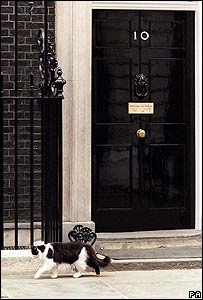
The homeless orphan who clawed his way from destitution to the very heart of the British Government serving under three prime ministers died at his retirement home in south London last week.

Humphery the former Downing Street Cat who wandered into the official residence of British prime ministers during the last days of Margaret Thatcher's permiership died in humble obscurity.

For years the black and white tom stalked the corridors of power ridding them of unwanted rodents at a rate that any corporate pest control operative could only marvel at. With his favourite Whiskas paid for by a Whitehall allowance of £100 per year Humphery became a well known and much respected official cat.

Humphrey, named after the civil servant in the television comedy Yes Minister became the only cat to be the subject of an official parliamentary question concerning the 'great robin massacre' which thanks to his political tenacity and frantic denials by his Cabinet Office minders, he managed to weather.

Shortly after Labour came to power in May 1997 rumers started to circulate that Mrs Prime Minister considered Humphrety to be unhygienic. The Labour spin doctors whirled into action arranging a photo call with Humphrey and Cherry in the garden of Number 10. The intrepid cat clung onto his job but was, as is the way in Whitehall, he was retired later in 1997. The Number ten press office put out a statement that a kidney problem rendered him unable to continue his work.

In an interesting twist The Daily Telegraph third leader today highlights a much talked about conspiracy theory that has been aired in the Westminster village. The rumour being that when Humphery had been destroyed on the orders of Cherie Blair.

The official line that Humphery had been retired on health grounds due to kidney failure has a serious flaw. How is it that the trusted retainer lived on an other 7 years to the ripe old age of 18 (over 90 in human years). Was the cat that died last week really Humphrey - had the original been ruthlessly put down by the new occupants in the autumn of '89 and the facts covered up ?

Suspicions will remain and add yet an other blot onto the history of Tony Blair's administration. This blog supports the call for a Royal Commission to establish the facts.


Additional research by Hector

Monday, March 20

Most people would just moan and pay up

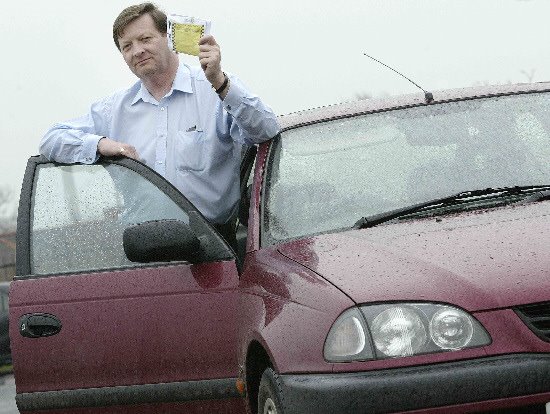
Peter Troy - Photograph with thanks to The Northern Echo
.
Case Dismissed
By Peter Troy
.

Regular readers will recall that my new years revolution (resolution) was to set an example and to be (even) more revolting. The week before last Durham County Council gave me an opportunity to advance my objective.

As reported by Gavin Engelbrecvht in The Northern Echo on Saturday I successfully overturned a fixed penalty fine (£30) attached to my vehicle in a Durham side-street last April.

The problem started when Sophie overheated - the long drag up the MI from leafy Surrey had proved a tad to much for my recently orphaned new acquisition.

Sophie - a two litre diesel Rover 75 was a symbol of the state of the once great British motor Industry. The demise of Sopie's (so very British to name ones car I feel) makers in Longbridge Birmingham had just been announced and the stress resulted in the old girl breaking down in Durham. Well to be precise she overheated in a zone two parking area in the ancient City of Durham.

The Northern Echo reported:

'' Magistrates in Durham accepted that Peter Troy's claim that he had parked in a restricted area to allow his engine {actually Sophie's} to cool.

Mr Troy of Sedgefield said '' I was articulate and able to argue my case. Most people would just throw up their arms and pay the fine''.

Mr Troy, a former chairman of the Darlington branch of the Federation of Small Businesses said his problems started last April when his Rover 75 overheated in Leases Court....''

Breaking down when in a hurry is very annoying which was made worse by that very British entity - the petty official backed by an army of automations.

Gavin Englebrecht continues the story:

'' He returned after giving the car time to cool down to find that he had a £ 30 fixed penalty fine.Mr Troy sent the ticket back {that very day} with a note explaining what had happened. But he got a reply some months later saying if he did not pay he would be prosecuted. The system had gone into automatic mode.''

Despite many attempts to discuss the matter with the 'authority' which is a combination of Durham County Council and National Car Parks it was impossible to speak with anyone who had the authority to make allowances for any 'mitigating circumstances'.

So it came to pass that on the morning of Friday 10 March I found my self waiting out side court number 3 at Durham Magistrates' Court opposite Her Majesties Prison Durham charged with:

''......failing to pay the charge prescribed by Durham County Council (Durham City Zone 2) ...... contrary to Section 47 (1) of the Road Traffic Act 1984 as amended.''

Well now, the prosecution solicitor had a thick file and a witnesses and I as they say in legal circles, was representing myself.

The first opportunity to upset the smooth running of my trial presented it self when I was asked how I pleaded. The clerk demanded my answer: ''Well sir'' I said ''I really don't know what to say.'' I am here because I did not pay, but I did not pay because I did not , I will argue, commit an offence. As the crime, that I am accused of is that I did not pay the fine - then I must plead guilty since I have not paid - but as I had not parked my car but had involuntarily stopped I am making a case to their Worships that I need not pay thus I am not guilty, but I admit not paying as stated by the Clerk on the summons to this court.

After some discussion which just about everyone in the court contributed to the case continued. I conducted my own defence in a manner of utmost respect to their Worships. However the Clerk was clearly less than impressed with my stout advocacy. After some 45 minites of detail accounts and questioning as to poor old Sophie's upset that day the Magistraits retired. Returning some half an hour later their Worships anounced in wonderful detail that ''the case had been dismissed.''

As I left the court I similed, but not smerked, as the usher opened the door for me - returning my smile I thought I heard him say ''bloody well done Sir'', but I could have been mistaken.