Saturday, March 17

In My View

The Aricle above is from The Northern Echo in January this year.
.
The piece below was published in The Journal on Wednesday 14 March.


Credit where credit is due – by Peter Troy

Rarely these days are the words, bank charges, bank profits, credit, and debt out of the headlines. What is very rarely in headlines is – what are the alternatives to high street and internet banks as well as high interest rate doorstep lenders.


Enter 'credit union' into Google and an amazing 44,800,000 entries are flagged up. So what are Credit Unions and why is the Government so keen to offer support? They are democratically - run co-operatives - which appeals to Labour’s traditional activists - they offer low-interest loans encourage their members to save regularly and also borrow at affordable rates. Importantly Credit Unions refresh the financial needs of people that the high street banks can't or won't refresh.

One key function of Credit Unions is to significantly reduce the influence of 'doorstep lenders' which were comprehensively criticized in a report last year; a £300 loan over 30 weeks would involve paying back around £450. A credit union loan would require paying back around only £320.

Credit Unions are well regulated and thus safe. Regulated by the Financial Services Authority they are co-operatively owned and run by the savers who are also members. Loans can be taken out for as little as £10 pounds or much larger amounts depending on how much has been saved. The system works because by members making regular savings they form a pool of money which is then available to be lent out to members who they have been saving for a qualifying amount of time (usually about 8-12 weeks).

Credit Union's are not new, their history dates back to 1864, when one Fredrich Raffiesen founded the first credit union in Heddesdorf in Germany. By the time of his death in 1888 credit unions had spread to Italy, France, the Netherlands, Austria, and North America and to a lesser extent Britain.
.
In recent years the concept has grown considerably to 560 across the UK - 16 of which have been established in recent years in the North East.

To establish a Credit Union there needs to be a common bond which determines who can join. For the Durham City and District Credit Union, which was launched in 2003 and has over 160 members, people have to live and work within the boundaries of the City of Durham but the common bond can be a place of work, church or community group. The essential ingredient in the establishing of a Union is the considerable efforts and dedication of groups of local volunteers.

In the North East, Credit Unions have received a welcome boost of publicity thanks to Durham MP Dr Roberta Blackman-Woods. The tenacious MP recently joined the City of Durham Credit Union and then immediately asked a question in the House as to what extra help Credit Unions can expect from the Government in the wake of the collapse of the huge savings club organized by Fairpark which was forced into liquidation at the end of last year causing much misery to thousands.

The prompt reply from Ed Balls, the enigmatic Economic Secretary to the Treasury stated that a Growth Fund of £36 million to boost coverage, capacity and sustainability of credit unions was being made available. The Government is also shortly to announce further funding to support the training requirements of staff and volunteers working for such organizations.

So there we have it the growth of co-operatives filling a role as much needed in the 21st Century as in the 19th. Clearly there is such a thing as society.
___________________
.
More information on Credit Unions can be obtained from the office of the Durham and City Credit Union 0191 375 7677.

Tuesday, March 13

The Lights Will Be Dim All Over Europe

Today's Daily Mail carries a long op-ed from Christopher Booker setting out the case against the ban on incandescent light bulbs which was requested by the leaders of the 27 member states at the European Council last week.
.
To put it in context, Booker writes of us now being deluged with news of the latest proposals from our politicians about how to save the planet from global warming, citing Gordon Brown and his "new world order" to combat climate change, coming on top of Mr David Cameron's proposals for strict "green" limits on air travel.

The Courage Of The Small Hours


A piece to be published on the blog in May will be pay homage to what the RAF Commander in Chief of Bomber Command, Air Marshal Sir Arthur Harris, perceptively called ''the courage of the small hours''.
.
The piece will be a modest tribute to the courage of the Airmen of RAF Bomber Command. Much has been very well written about the Batttles of the Bomber War but little by those that lived through those years. I am keen to meet and chat to anyone who is wishes to share their memories and thus help my piece be different to what has been written before.
.
Why bother - well, for if such as I (and subsequent generations) born after the events of the second world war know why, how and when so much courage in the air was show then ' their name (and courage) will live for evermore.'

The 2nd World War Bomber Command death toll was a huge 55,573. It is a national disgrace that they have no national monument - the reasons for which I shall explore in my posting in May. It is important that the one hundred thousand men from Britain, Australia, Canada, South Africa and other Commonwealth countries who fought those battles over Germany are given their proper place in history.

Monday, March 12

Link at the Bottom


Click below

http://www.brugesgroup.com/cost_benefit_lobby/

Warming to Janet Daley

As a contribution to the ongoing debate on global warming – or "climate change" if one prefers - it would be hard to improve on the op-ed written by Janet Daley in today’s Daily Telegraph.

Too Late to Save the Crown


Save the crown! That's the message from some of Britain's biggest brewers who last week pleaded with Tony Blair to save the 300 year-old Crown symbol on beer glasses from extinction at the hands of Brussels-based bureaucrats. Not that our Prime Minister can do much about the matter; it is alas far too late.
.
The Crown symbol was first used in 1699 as a guarantee of the size of pints and half pints. But this year it is due to be removed and will be replaced by the an EU-wide CE mark guaranteeing the accuracy of measures.The UK has already signed up to the EU's measuring instruments directive, which came into force last October, triggering the phasing out of the Crown mark in favour of the Conformité Européenne logo.

In their letter to Tony Blair the nine brewing and pub companies wrote protesting at the EU's interference by the removal of the Crown is a “needless” intrusion'' into a system which has worked well for centuries. “We feel that it has been imposed on our industry without consultation and against the wishes of our consumers. This directive is yet another in a long line of examples of excessive interference from Brussels which only serve to undermine support for the EU among business leaders and the wider public.”
.
Well the beer bosses are quite right. But EU intrusion is nothing new and the phasing out of the Crown mark has been a very long time comming.
.
Where one must ask have the leaders of beer industry been over the last 35 years. Have they not been listening to the many debates in Pubs through out the land on the 'interference' from the EU? As the old saying goes ''if you do not take an interest in politics then politics will sooner or later take an interest in you''.

Sunday, March 11

The Sunday Quote

''Our country is not the only thing to which we owe our allegiance. It is also owed to justice and to humanity. Patriotism consists not in waving the flag, but in striving that our country shall be righteous as well as strong''
.
James Bryce quotes (1838 -1922) - British politician, diplomat, and historian)
.

Saturday, March 10

More Nonsense

Looks like the EU Parliament has discovered a new way of spending another £1.3 million a year of our money. Dan Hannan has the details.

CFP - ''Morally Wrong''

.
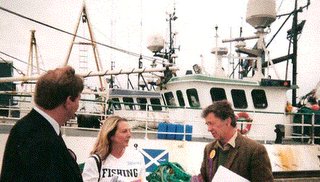
Flashback to January 2004. Peter Troy, then an activist in the North East Federation of Small Business wrote a detailed article on why what was one of the world's most productive fishing grounds, the North Sea, is under threat of closure to cod fishermen. Peter went on to comment in the North East and Scottish press that the British off shore fishing industry, made up entirly of Small Business could once again be thriving; a cause that the FSB were and remain less than enthusistic to even mention.
.
The photograph above shows one of the three remaining commercial fishing boats leaving the North Sea port of Hartlepool.
---------------
.
Last week Joe Borg, of Malta, the European Fisheries Commissioner and thus in charge of the British Fishing Industry described the EU's Common Fisheries Policy (CFP), and in particular EU's quota system, as "morally wrong". He admitted that, under the CFP rules, 880,000 tons of fish are having to be dumped each year in the North Sea alone, and that in some waters around the British Isles, more than 90 per cent of all the fish caught are having to be discarded (compared with an average in Norwegian and Icelandic waters of only 4 per cent).
.
Amazingly, there are still some people who think that the EU is good for us !
Above, Peter Troy campaigning with Morag of the Cod Crusaders and a local politican on the North East coast of Scotland.

Friday, March 9

The Great Swindle

Channel 4 Television yesterdayshowed a documentary entitled "The Great Global Warming Swindle" which was a most effective popular debunking of the Global Warming Scam.
.
What came over with crystal clarity from the programme was the fragility of the science supporting the global warming thesis, and the strength of the science supporting the arguments that the primary driver of climate change was the sun.
.
It can thus come as no surprise that the EU, built on a foundation of deception and fraud, should buy into this scam, seeing in it a means of pursuing its interventionalist agenda at a time when its mantra on "keeping the peace in Europe" has little relevance to the upcoming generation.
.
In an attempt to keep the interest going, the EU has sought to harness the ill-founded concern over climate change, engaging in the "battle to save the planet".What is especially of interest is that, in choosing this battle, the EU has effectively opted out of the real battle, the global war against terrorism which, from all accounts, has reached new heights of ferocity in Afghanistan.
.
Not only are we seeing a major battle for control of the Kajaki dam region but, some 40 miles away at Sangin, there has been also fighting on a large scale – where four British soldiers have now been killed in the last week.
.
Quite how intensive it has been is illustrated by the airpower summary for 7 March, which shows the scale of air operations in support of ground forces. There we have the tale of two worlds – the one of the fantasy world of battling to save the planet from climate change, and the other, real world battle to counter the global threat from terrorism.
.
Not only has the EU bought into the former but so has our government and – stupidly – David Cameron had that unique opportunity to create clear blue water between the Conservatives and New Labour but, instead, has fallen for the myth.

Tuesday, March 6

A Sad Case

An interesting piece today in The Northern Echo by the Reverend Dr Peter Mullen who is Rector of St. Michael’s Cornhill, in the City of London and also Chaplian to the Stock Exchange.

The Rev. Gentleman takes as his theme a recent revelation that an estimated 70,000 people in Britain are suffering from dementia is probably in fact a gross under estimation.

Two points that the Reverend highlights, firstly the shocking truth that there are so many that are deadened by dementia that they never pick up a newspaper but sit around grinning hideously over the pictures in Heat and Hello magazine. The second sad example is a case when dementia reaches its terrible and irreversible stage. Dr Mullen sites
one of his parishioners, who was in the stages of advanced delusion; the city gent was under the impression that David Cameron was some sort of Tory; poor deluded man. Clearly no hope.

Sunday, March 4

£ 55,660,000,000


This blog has made many references to the cost of EU regulations in the past. It is right that we continue to highlight this issue because the media so often makes a mess of the key points.
.
As Christopher Booker reports this week in his regular column in The Sunday Telegraph a new study by the British Chambers of Commerce (BCC), shows that the total cost to business of new regulations imposed since 1998 is a huge £55.66 billion.
.
One of the reports in a national paper thunders "Labour's £55 bn roll of red tape", all this was blamed on the Labour Government. Yet it might have been rather more useful and interesting to quote from the BCC's website, which shows that £40 billion of this cost, or 72.5 per cent, is due not so much to "Labour" regulations as those emanating from the EU. This is one of the reasons that I proposed at the Federation of Small Businesses (FSB) conference a few years ago that the organisation should demand that the UK leaves the EU. The branch delegates agreed by a majority of over 2 to 1; yet curiously the FSB did not adopt the matter as a policy.

Perhaps some of the 215,000 or so members of the FSB in the UK might like to ask at this years confrence how much cost the EU actually has to impose on its members before the FSB listens to its members wishes. Just a thought !

Basra Success

British troops achieve much needed success in Basra. See link -- Labels: ,

The Sunday Quote


''Give up what appears to be doubtful for what is certain. Truth brings peace of mind and deception doubt.''

Muhammad Ali quotes (American Boxer and Activist, b.1942)

Similar Quotes.

The editor in posting this quote is mindful of John Wright's comment in his leadership election address to FSB members. Mr Wright commented '' ...we the (FSB) are punching well below our weight. '' Mr Wright also exaggerates his length of business experience by almost four times, he claims a background rooted in small business whilst his background in reality is that of a public service employee and trade union official for what was one of the most anti-business of unions - NALGO.
.

Thursday, March 1

From the Editor's Crutches


Hospital waiting rooms are very annoying places especially when they are divided up into sub-waiting areas I concluded yesterday whilst waiting for further medical attention to my shattered right Right Tibia and Fibula. Attempts at injecting humour into these situations is rarely successful and yesterday was no exception.

Clearly frustrated at my slow and hazardous progress towards the treatment room a health care assistant asked if I was given any training in the use of my crutches before being discharged from hospital. I confirmed that I had but the crutches were clearly for right-handed patients and that as a left-handed person I had been wrongly supplied. I am sure I heard the care assistant say to her colleague in the corridor ''what a shame'' - whether that was aimed at me or my right handed crutches I was and remain unclear.

Later it occurred to me whilst waiting for an X ray in the (annoyingly titled) sub-waiting room that it was, to the day, the 5 th anniversary of my Heart Attack. At the time of writing I am still unconvinced that spending the morning at my local fractures clinic is the most appropriate way to 'celebrate' the sobering events of five years ago or not. But alas that is where I found myself.

As I have commented on before, one of the characteristics of public sector waiting rooms is the large number of people who sit waiting their turn without any apparent thoughts in their heads. Only but a few can be seen reading a newspaper or indeed anything other than the largeprint notices written as if their readers were junior school pupils. One such notice read ''why we must wash our hands''; why 'we' ? Another written in bold was about abuse of NHS staff. A matter of great concern I agree, but why assumed that all those waiting for treatment were actively considering abusing the nearest nurse; the assumption of negativity is of course infectious. It was only lack of mobility and a decent marker pen that prevented me from adding some cryptic comments.

Whiling away the time I spotted a piece in my newspaper ''Prince Charles demands Macdonald's be closed down''. Now I have been saying that since the '80s when it was revealed that the fast food poisoner was donating vast sums of money to NorAid - a fundraiser for the terrorist organisation the IRA. HRH was quite emphatic - the junk food resturant giant is a public menace because of the unhealthy junk sold to young persons by young persons at vast profit. The muli-branch menace should be banished from the Realm !

In my enthusiasm for Prince Charle's bold stance I pointed out the article to my waiting room neighbour, are large tatood chap also with a leg in plaster. His retort of ''silly bugger'' was not quite the reply I was hoping for. Anyway satisfied that that morning I had organised one of my clients to make salient and 'SoundBite' comments on BBC Radio (at amazing short notice) I felt that I had done my bit to support the Heir to the Throne in his latest controversial stance.

All in all not the most productive morning but one in which I was able to observe my fellow British Subjects (in the North East) at close (and fractured) quarters. On my next visit in April I will obtain a large number of assorted newspapers and distribute them free - I wonder what the reaction will be - after all someone needs to take care of patient communications.

Our Borders with the EU


Following on from its launch adverts in October last, the Speakout campaign (funded in total by Yorkshire Businessman Paul Sykes) is back in the fray with a second wave of avertisments in the national and regional press. The ad copy tells us how:
.
Without a debate or vote in Parliament our elected MPs have handed control of our borders to the European Union, allowing unlimited immigration into Britain from EU countries. We are then told that "80 percent of you, the people", want a vote on getting your borders back. So far so good, but a corresponding entry on
the website talks of the "Free Movement of People directive" which:
…was subject to no debate in the House of Commons and no vote, but discussed in a secretive, and largely ineffective, group of mostly Labour MPs, called the European Scrutiny Committee. This Directive renders Britain – and all the other 27 once sovereign nation states that now comprise the EU - effectively borderless provinces in a new country called Europe.
.
The actual directive to which Speakout is referring is our old friend, with the snappy title of:
.
Directive 2004/58/EC of the European Parliament and of the Council of 29 April 2004 on the right of citizens of the Union and their family members to move and reside freely within the territory of the Member States amending Regulation (EEC) No 1612/68 and repealing Directives 64/221/EEC, 68/360/EEC, 72/194/EEC, 73/148/EEC, 75/34/EEC, 75/35/EEC, 90/364/EEC, 90/365/EEC and 93/96/EEC.
.
But what is a little puzzling is that this is simply a directive which codifies and clarifies the "right of citizens of the Union…". It does not actually confer any rights. These actually came with the EC/EU treaties and are currently expressed in: Article 14 (7a) ECT: establishing the internal market, which includes the free movement of persons; Article 18 (8a) ECT: Union citizens have the right to move and reside freely within the territory of the Member States; and Article 61 (73i) et seq: new Title IV, "Visas, asylum, immigration and other policies related to free movement of persons".
.
All the treaties which currently apply to the UK were in one way or another subject to pretty extensive debate, both in the Houses of Parliament and outside. That is not to say that the debates were by any means satisfactory but the fact of them rather neutralises the point Speakout is trying to make.
.
This notwithstanding, the campaign got something of a kick when three newspapers, The Sun, The Daily Mail and the Daily Express, all refused to run the add because, they claimed, it was "potentially racist" and possibly "inflammatory". Coming from those three newspapers, says Speakout, "they've got to be having a laugh", in that, at least, the campaign has got it right.

Wednesday, February 28

The Federation of Small Businesses

This week ballot papers have been sent out to the 205,000 plus members of the UKs largest business organisation - The Federation of Small Businesses (FSB) - to elect a new leader.

The FSB, as we have comment on before, has been hijacked by europhiles - a fact that is unknown to most members. Our piece first published in January is linked here:

http://verybritishsubjects.blogspot.com/2007/01/collaborator-v-appeaser_20.html.

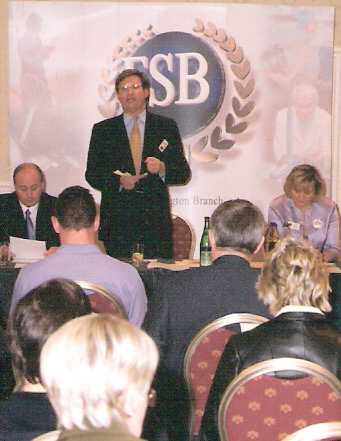
The picture above shows Peter Troy addressing a Branch meeting shortly after he had succesfully persuaded the FSB's annual conference in 2001 to pass a motion for members to demand a withdrawal from the EU.

More comment to follow soon.

Monday, February 26

Don't mention the Commonwealth

By Christopher Booker
.

My son, returning from a business trip to India, was amazed how little coveragewas given here to the expulsion of 16,000 Indian doctors working in the NHS. InIndia this remarkable decision, based on the recent upholding of a High Court judgment of last November, has made front-page news for the past two weeks. It is widely interpreted as blatant and racist discrimination against Commonwealth citizens.
.
Not so widely understood was why Mr Justice Stanley Burton had little choice,last year, in ordering the Indians' expulsion. He was merely enforcing theImmigration (European Economic Area) Regulations 2006, implementing EU directive2004/38. This made illegal a system set up by the 1971 Immigration Act, underwhich thousands of Commonwealth doctors every year could complete theirpost-graduate training in British hospitals, without a work permit, beforereturning to their own countries.
.
The new law has meant intense hardship for thousands of Indians, many of whommade great sacrifices to get here, and more than 5,000 of whom have already beenforced to return home. One, Dr Imran Yousaf, who challenged the legality of theban with the British Association of Physicians of Indian Origin, committedsuicide shortly before this month's ruling.
.
Among those who have spoken outstrongly against the judgment are the British Medical Association and Lyn Nazemi-Afshar, the UK Independence Party's candidate in Birmingham Ladywood, whodescribed it as "EU discrimination against the Queen's Commonwealth".
.
The EU's gradual removal of the rights of citizens of the Commonwealth to workand live in the UK has long been a cause of surprise and distress in the Commonwealth. It was a few years back that Australian and New Zealand doctors and nurses wishing to work in the UK were startled to learn that, under anotherdirective, they now had to demonstrate, among other conditions, their ability tospeak English. To Poles, Latvians, Slovaks, Romanians and other EU citizens nosuch requirement applies.
.
The latest restrictions follow those I reported last year by which manyCommonwealth and US citizens who had lived in Britain for many years, given"indefinite leave to remain", were told that, under new EU rules (even if they had married British citizens), this was now suspended.
.
It is not generally grasped just how consistently, ever since Britain joined the European Community in 1973, the need for us to turn our back on the Commonwealthhas been regarded as a litmus test of our desire to become "good Europeans". But, of course, anyone who points this out is likely to be branded a"xenophobe", including no doubt Mrs Nazemi-Afshar.

Sunday, February 25

The Sunday Quote

'' It is amazing how wise statesman can be when it is ten years too late.''

David Loyde George, 1932. One time British Prime Minister.

Wednesday, February 21

The Fall of Troy


I am flattered by the large number of 'phone calls and emails from well wishers following an accident. The sad story is as follows:

Tuesday 6 February was the fifty-fifth anniversary of the succession of Her Majesty Queen Elizabeth II to the Throne on the death of her Father King George VI. It was also the day Troy fell. That's me Peter Troy not the ancient city of the Greek myth. The fall was unheroic - ice on a back door step caused me to tumble to the ground and break my leg, badly

The diagnosis: '' Fracture Distal Tibia and Proxoimal Fibula Right Lower Limbright Tibia '' was as much a test of my Latin as it was of my ability to bare the pain.

The operation: '' Open reduction internal fixation with locking plate Right Tibia '' sounds as nasty as it was. For the operation, which lasted for 101 minutes, I elected to have an epidural rather than a general anaesthetic - well if the Anaesthetist was going to stay awake during the operation the least I could do was the same and it did mean I could discuss the workings of the NHS directly with the Consultant whilst he was fixing the stainless steel plate to my bone. I assume the plate is British Stainless Steel.

The result; well for the next four weeks I shall be propelling myself about somewhat hazardously on crutches and or with the aid of the NHS 7343C - it is far too depressing to refer to it by its more popular name, a Zimer-frame. I will be unable to drive for months and I will need the aid of a stick to walk for some time. All of which will put me in an appropriate mood for a meeting (14 March) with those small minded 'trade unionists' that tried to send me to Coventry!

.
Below is a letter that was published in The Northern Echo last Monday which is I hope self explanatory.


Sir

At a time when there is so much criticism in the press of the NHS I think that is only right that I highlight through this column all those involved in the treatment last week in both Accident and Emergency and Ward 32 of North Tees University Hospital of a somewhat cantankerous and impatient patient who succumbed to the dangers of ice, fell and broke his leg.

Dispite the many failings of the bureaucratically misfocused, politically orientated senior management of the NHS my observations from an eight day stay in a hospital bed at North Tees University Hospital was that world class treatment and nursing was delivered, without exception by all the staff involved in my care, this was done with both professionalism and humour.

I hope this very public thank you acts as an incentive to continue the excellent work.

Peter Troy

Monday, February 19

Rhetoric -v- Reality. Road Charging

In two different newspapers, by two different columnists – contemporaries both – are two different stories, both about road charging. One is by Christopher Booker in The Sunday Telegraph and the other is by Simon Jenkins in The Sunday Times.
.
Few things better illustrate the growing divide between rhetoric and reality, so much so that, although they are writing about the same things, the two columnists might just as well be on different planets.
.
As to the rhetoric, it is Simon Jenkins who thinks that Britain will have some form of road pricing, like it or not, sooner or later. The idea, he writes, has been about for decades and now its time has come. But, as he explores the options, it is very clear that he has absolutely no understanding of the fact that future provision will be governed by EU law.
.
The task of explaining The reality, in a fraction of the space, is given to Christopher Booker in his column, where he tells us that new systems will have to conform with EC directive 2004/52 on "the interoperability of electronic toll collection systems", to ensure that all the EU's planned road charging schemes are similar.
.
Booker then goes on to tell us that there are substantial problems arising from this. Firstly, Brussels is committed to drawing up a "technical standard", to which all national systems must conform, and so far, due to the huge technical problems involved, there is no sign of it emerging.
.
Secondly, the EU scheme is to be based on the EU satellite system Galileo. Galileo, despite the fanfares which greeted the launch, courtesy of a Russian Soyuz rocket, is a shambles.
.
Now, the difficulties outlined by Booker are going to have a profound impact on the rollout of electronic charging schemes. The trouble is that, despite the government being well aware of the implications, politicians like Douglas Alexander are currently in denial.
.
When journalists such as Jenkins (and there are many of them) then fill up space in a leading national daily, chuntering on as if the EU did not exist, as if we in the UK were masters of our own domain, and as if there were no overwhelming technical and political problems, it is no wonder the public are so ill-informed.

Sunday, February 18

The Sunday Quote

Democracy is a devise which ensures that we shall be governed no better than we deserve.''

George Bernard Shaw (b. 26 July, 1856, d. November 2, 1950).
.
Shaw was born in Ireland but spent most of his adult life in England. Famed as a playwright, he wrote more than sixty plays; he was a very British thinker. Shaw was uniquely honoured by being awarded both a Nobel Prize (1925) for his contribution to literature and an Oscar (1938) for Pygmalion). He was a strong advocate for socialism and women's rights, a vegetarian and teetotaller, and a vocal enemy of formal education.

No Smoking - More Hypocrisy

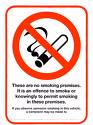
On I July smoking will be forbidden in pubs, bars restaurants, taxis, buses and all indoor public places in England and Wales. Smoking has been banned in the same public places in Scotland since last summer.

In keeping with the control obsessed style of our government local councils have already been given £29.5 million of tax payers money in order to train staff to enforce the no-smoking ban. The Government could of course given the money to much needed medical research, spent it on looking after patients with cancer or hiring more much needed nurses for the NHS - 29.5 million would pay for 840 trained nurses over the next twelve months. But no - the money will be spent on 1,000 'smoking police' so that they can perform the 'essential ' task of issuing fines to smokers who are caught in the dreadful act.

The millions spent on the no smoking enforcement officers has to be a seriously crazy decision when one considers local authorities between them already employ an army of officials who are expert in the practice of issuing large numbers fixed penalty fines to the general public: parking attendants. Training these relentless automatons how to use an additional book of sticky tickets should not cost £29.5 million.

In Scotland large numbers of inspectors were trained on how to enforce the ban. Since when they have had nothing to do only 11 fixed penalty notices have been issued in the 10 months that the ban has been in force. Clearly bans on smoking in public places have proved to be almost perfectly self-enforcing. Well ok with one exception. The only place smoking will be permitted inside a public building throughout the whole of the EU is in the EU Parliament buildings in Brussels and Strasbourg !That the parliament buildings are now havens for smokers is not for want of trying it has to be said. On 1 January, the 16-strong committee of presidents actually banned smoking, only to find that the ban was extensively flouted by both MEPs and staff. Bowing to reality, therefore, the committee – which has 12 smoking members – voted to rescind the ban.
.
This action by the EUP is hardly surprising – the parliament has always had an ambivalent attitude to smoking. The first time I ever visited the EU Parliament complex in Strasbourg, back in September 2002, the first thing to greet visitors was the overwhelming scent of Gaulloises despite the many EU "no smoking" signs.

Today the
Sunday Times has picked up the story and records Deborah Arnott, director of the antismoking campaign group, Ash, describing the latest decision as "scandalous". "There can be no justification for politicians to place themselves above the law and it makes a mockery of the commission's proposals for an EU-wide smoking ban," she says.
.
Indeed so Deborah - welcome to the world of the EU hypocrisy with its armies of enforcement officers.

Saturday, February 17

What is it we are fighting for ?

Time for a rant, thinks Dr Helen Szamuely. It is time to ask ourselves, what it is we are fighting for? Not against, but for.
.
So, let the debate begin.
Here is the opening (prolonged) salvo.
.
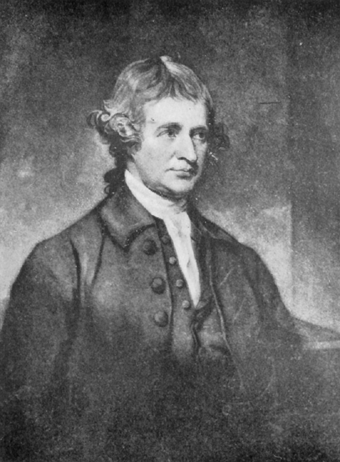
And next. Do we want politicians of principle? Who could deny that Edmund Burke was a politician of integrity and principle? Well, actually, quite a lot of people do, his personality being capable of exciting screams of frustration 210 years after his death.
.
Nevertheless, his words, quoted in the excellent posting (where Helen is at her very very best) seem a good discussion point when trying to resolve that vexing question: what is a politician of principle and do we really want them?

The End of Week Quote


The First Sea Lord Admiral Sir Jonathan Band provides our end of week quote is spectacular style. According to The BBC, the Admiral claimed that Britain faces a choice between remaining as a first division sea-going nation or "turning into Belgium".
.
This was at a press briefing where he told the assembled journalists that his price tag for avoiding this horrible fate was "another £1bn" to safeguard future capabilities - and the delivery of extra two aircraft carriers.
.
"The Royal Navy is a very special asset, and if you want to use it, it doesn't come for nothing," he is said to have told the journalists, adding, "We're at a scale now that requires a certain amount of investment to maintain … You can't do deterrence unless you are a really professional outfit."He summarised his position to journalists: "Give me two carriers and just less than a billion and I will be off your back, a happy boy".
.
No sooner was the news out, however, than Sir Jonathan was backtracking faster than a French tank in reverse. Up on the MoD website went a statement declaring:

I do not think, and have not said, that the Royal Navy needs a £1bn-a-year extra to do its job or to keep ships at sea. Today's Royal Navy is funded to do what is asked of it – not least thanks to a current investment programme of £14bn, and the delivery of 28 new ships in the last decade alone.
.
All this is a day after the House of Commons Defence Select Committee warned that the Royal Navy could be left without working aircraft carriers because of continuing delays and doubts surrounding the MoD's management of the £3.6 billion project to buy new vessels.
.
The Scotsman, being the only British newspaper to carry the item, cited the Committee as saying that the whole future of the Royal Navy as a fighting force was uncertain and hung on decisions ministers will take in the next few months. The biggest of those concerned the formal placing of the order to build two new aircraft carriers, which was by no means assured.
.
Anyhow, the next day, Sir Jonathan socks it to 'em, and then backs off immediately. You really have to admire the intestinal fortitude of the chap, don't you.

Thursday, February 15

Alive but not kicking

Well, your Editor is back, alive but not kicking. As my services as a 'blogger cat' are no longer required I will sign off - until the next time.

Hector (The Blogger Cat)

The Germans Role Out The Constitution

On the excellent blog site England Expects one can read a disturbing account of the state of play on the EU constitution, and the role of German chancellor Dr. Angela Merkel in pursuit of a resolution to the issue.

But, whichever way you cut it, hers is a high risk strategy with only a limited chance of success and, set against that, are the risks of re-opening old wounds which emerged during the French and Dutch referendum campaigns. It is something of a mystery, therefore, as to why Dr Merkel should be expending so much political capital on such a hazardous venture. Part of the reason is explored on the posting: .

Tuesday, February 13

Road Deaths - The Facts


It is too early yet to focus the blame on anyone in particular but, if there are any officials with brains and a sense of self-preservation in the EU Commission's transport directorate, they will be looking very closely at the latest figures for road deaths in the UK.
.
These have been released by the Department for Transport and indicate that, in the 12 months to September last year, these deaths increased to 3,210, compared with 3,177 in the same period a year earlier. Much of the rise was concentrated in the summer months between July and September, when 840 people died on the roads, compared with 818 in the corresponding period in 2005 - up three percent. During that time, the number of fatal accidents rose by five per cent, from 745 to 780 crashes.
.

.
At least one media report notes that this increase has occurred "despite the proliferation of speed cameras", although some might argue that the increase has occurred because of the proliferation of speed cameras.
.
It is Kevin Delaney, former chief of the Metropolitan Police traffic division and now head of road safety at the IAM Motoring Trust who is sounding the alarm, declaring that, "Any figures that show an increase against a downward trend ought to be ringing alarm bells in Whitehall, in local authorities and in police headquarters."
.
Typical of his kind though, Mr Delaney does not seem to have appreciated that the European Union has, since 1991, gained competence over road safety and has recently started flexing its muscles in this policy area. Why the figure should be of such great interest to DG Energy and Transport is that the UK is the "safe man of Europe" with historically the lowest fatality rate of the EU 15, standing at 6.1 deaths per 100,000 population in 2001, compared with 13.8 in France and a horrendous 21.0 in Portugal.
.
However, it is also the UK which has bought in most heavily to the "Speed kills" message, the government focusing most of its road safety effort on this single factor.
.
The rot started in 1991 when the then Conservative government launched its £1 million "Road Signs" TV advertising campaign in the October. The advertisements used "travelling" road signs to illustrate the different survival rates of being hit at 20/30/40 mph, promoting the slogan: "Kill Your Speed. Not a Child".
.
This progressed to a £2.3m TV campaign spend in September 1992, £1.5m in April 1993 and another £1.5m in September 1993, followed by a further £1.5m in April 1994 and £1.2m in September 1994. It was in that last September campaign that the advertisements carried the new slogan that has become so familiar: "Speed Kills. Kill Your Speed".
.
The spending continued, backing up the new slogan, with £2.5m allocated in 1995, and nearly £3m in 1996. The slogan transmuted into: "At times we all drive a bit too fast ... Kill Your Speed" and in 1996, for the first time a kill your speed "hand symbol" was designed and used in television advertisements and publicity literature.
.
With a change of government in 1997, spending increased to £3.5m for that year, but the "Kill your speed" theme continued. Currently, the spend is £2.1m, with the campaign focusing on counteracting "the widespread public perception that smaller increases in speed will not have the same repercussions as larger ones."But the new government did not confine itself to mere advertising. Imbued with the "Speed kills" message, in December 1999 it announced the formation of what were to be called "camera partnerships" where local authorities, the police and the courts banded together in their areas, to run speed cameras and collect the fines, the bulk of which revenue they were allowed to keep.
.
Eight trial areas were announced which began on 1 April 2000. The trials soon became permanent and now there are (as of April 2006) thirty eight camera partnerships in England and Wales covering forty-one police force areas out of a total of forty-three.
.
In 2004 - the latest year for which Home Office figures are available - 2.1 million motorists were booked for speeding. Drivers forked out £114.5 million in fines last year, with a £60 ticket issued every 15 seconds. The number of cameras, from a mere handful in 1999, has grown to over 60,000, earning on average £36,000 each year.
.
The results have been all too obvious. From an annual level of 4,753 in 1991, deaths had dropped by over 1200 annually in 1999, to 3,564. But, in 2000, the decline started slackening off to 3,580. In 2001, it increased to 3,598 and in 2002, the figure was 3,581, still higher than the level in 2000. By 2003, it had only reached 3508 and the figure stood at 3,221 in 2004.
.
While some will blame the effect of speed cameras, there are obviously complex effects at play, not least the fact that as robotic speed enforcement has increased, there has been, according to the RAC, an 11 percent reduction in traffic officers between 1996 and 2004. Other estimates suggest cuts of up to a fifth in some forces between 1999 and 2004.
.
Furthermore, there has developed a kind of motoring "underclass" of two million drivers who evade camera fines by driving unregistered and uninsured vehicles.
.
Then, others – such as campaigner Paul Smith, founder of Safe Speed – argue that the emphasis on speed and an over-reliance on cameras for enforcement is making our drivers worse. Speed cameras and "speed kills" policy is badly affecting driver skills and driver attitudes, he says. "Drivers are so concerned about getting a speeding ticket that they are less likely to concentrate on the road ahead."With opposition to speed cameras quite clearly growing, the EU has thus walked into a situation where, progressively, it is taking over a road safety policy that is not only highly unpopular but also – if the present trend continues – as failure. But rather than the government being seen as turning a success story into failure, as the EU increases its profile on road safety, it will undoubtedly attract some – and then an increasing amount – of opprobrium.
.
In April last year, the EU commission signalled its intention to take a much greater role in road safety. But what it signals in fact is the inevitable failure of the Commission - which has set as its target the reduction of road deaths across the EU in the ten years to 2010 – is an evaluation of the variations in road death rates across the UK.
.
In Glasgow, for instance, deaths have increased but the toll is in the number of elderly people knocked down and killed. This has almost doubled in a year, with Glasgow City Council reporting 11 pedestrians over 60 dying as a result of road traffic accidents in 2006. The year before, the total was six. The elderly deaths helped to push the overall death toll from road accidents in the city up to 18 pedestrians from 13 in 2005.
.
In Mid Devon, there is also a doubling of road deaths, with 11 people dying. The police report the single most frequent problem involved drivers or motorcyclists losing control while negotiating bends.
.
North Yorkshire, however, reported road deaths down by a fifth and, in this county, the success is put down to "an increasingly successful campaign" to drive down the number of fatalities after a concerning rise in deaths, especially among bike riders. Road deaths fall from 85 in 2005 to 68, while fatalities among motorcyclists have been reduced by 38 per cent – 13 died last year, compared with 21 in the previous 12 months.
.
Shropshire also bucked the rising trend, with 23 people dying in the year, compared to an average of 27 deaths per year between 1994-8. But the police were not abler to offer any specific reason for the fall.
.
The point here is that the actual causations of deaths throughout the UK are likely to differ significantly from area to area, so control strategies will also have to be different. Even in the UK, away from the "Speed kills" mantra, there is no "one-size-fits-all" quick-fix answer to road safety. For the 27 member states of the EU, the picture is even more varied, making road safety even less amenable to centralised EU treatment.
.
For the EU Commission, therefore, the UK experience should serve as an early warning of what happens if its gets it wrong. Not, of course, that it will.

Editor's Survey on the NHS


Well, your Editor should be home some time today after completing his 1 week survey on the NHS. Mind you, I do think that breaking his leg in order to become a patient was taking things a little too far. I suppose I will have to give up the comfortable chair in front of the fire. Oh well, all good things must come to an end.

Hector

Sunday, February 11

The Sunday Quote


“If we get in an accident that's strong enough to break bones, it's going to break bones. What makes me a little bit higher risk is that if I break my right ankle again, I've got a bunch of screws and plates in there, and that would not be good.”

Alfred Unser (born May 29, 1939 in Albuquerque, New Mexico) is a former American automobile racing driver. He is the second of three men to have won the Indianapolis 500-Mile Race four times, the fourth of five to have won the race in consecutive years.

Your Editor may not have been doing anything as glamorous as racing cars but he broke the record for getting down the steps! He is recovering well and should be back next week.

Hector (the blogging Cat)

Wednesday, February 7

Editor with Broken Leg


Your Editor will be off line for a while. Yesterday he fell and broke his leg, he is now in hospital awaitng transportation to the operating theatre. Bulletins will be posted and I will endeavour to post comments.

Hector (senior cat of the household)

Monday, February 5

The Flames of Rubbish

By Christopher Booker,

Unlikely alliances forged in the flames of rubbish


.
Anyone concerned with the curious way Britain is now governed might briefly switch their gaze from the sight of policemen trooping in and out of 10 Downing Street to Virginia Water, the well-known Surrey beauty spot. Here, residents are up in arms over Surrey County Council's plans to build a giant incinerator with a chimney 140 feet high, to assist in disposing of the county's 580,000 tons a year of domestic waste. The people of nearby Guildford are equally incensed: 90,000 of them have written to protest at Surrey's plans to build a similar incinerator outside the city.

It does not take long on Google to find similar rows raging across the land, from Sussex to Perthshire, from Dorset to Norfolk. It is only a month since a High Court judge threw out a case in which Ken Livingstone, as Mayor of London, joined with Bexley Council to stop the building of a £230 million rubbish incinerator on the south bank of the Thames. Indeed a striking feature of these battles is how they forge such unlikely political alliances - Ukip-ites in Virginia Water alongside Greenpeace, Lib Dems in Norwich at one with Labour councillors in Cheshire. Everywhere these protesters, having done their homework, make the same points.
.
Giant incinerators, working round the clock, are an absurdly wasteful way to dispose of rubbish. They use a great deal of energy and generate large amounts of CO2 and hundreds of lorry movements a day (not much fun to live next to).They create much more pollution than their developers like to admit, not least the hundreds of tons a day of toxic ash which then has to be transported 100 miles or more to one of our few remaining hazardous waste sites, such as the one near Cheltenham - which people also do not find it fun to live near.

But what the protesters also discover, as did Mr Livingstone last month, is that there is very little hope of stopping these incinerators being built, because the county and borough waste authorities have no choice. They are forced to put them somewhere because our Government is obliged to implement a waste policy imposed by the European Union, which dictates that by 2020 we must reduce the amount of waste we landfill to a third of its level in 1995. We are so far short of our EU targets that, as the National Audit Office reported last year, our local authorities will soon be incurring fines from Brussels of £200 million a year.

The idea is that we should increase our recycling of rubbish to 27 per cent (which in reality means shipping millions of tons of waste collected for "recycling" to other countries such as China). The only other way we can legally dispose of up to half our rubbish is by building these huge incinerators, which make very little economic or environmental sense, and which cause such distress to those living nearby.

All of which should put the utter shambles this country is making of its waste disposal near the top of the political agenda, not least because there is not a scintilla of genuine democracy in the way in which it is being imposed.

It is obviously no good looking to the Labour Party to do anything about it, because it is locked into the idea that everything imposed by the EU must be obeyed. But it is equally no good looking to the Not-the-Conservative Party to question the policy, since this would raise issues that David Cameron would rule out of order as "banging on about Europe".

So we are stuck, forced to endure a totally absurd system which bears no relation to the particular requirements of the United Kingdom and which is making large numbers of people very unhappy.

The very least our politicians can do is to admit honestly that this is where we stand, and not try to pretend ever again that we live under a form of government that merits the name of democracy.

________________________
.
What continues to amaze is that, after the total shambles of EU environmental policy to date, anyone can possibly think that the EU is "good for the environment".
.
The cost of EU enviromental policy to Bistish Businesses is massive. Small businesses in particular suffer from the vast amount of legislation that non-sensically impacts on small businesses, a fact that is well known to the Federation of Smalll Businesses (FSB). In the ongoing election for a new National Chairman of the FSB members may well wish to concider that John Wright (see collaborator-v-appeaser_20.html) supports EU environomental policy; though to be fair it is unlikely he is fully aweare of all the details.

Sunday, February 4

The Sunday Quote


"Those who have been once intoxicated with power and have derived any kind of emolument from it, even though but for one year, never can willingly abandon it."

Edmund Burke - 1729- 1797
(Letter to a Member of the National Assembly 1791)

Friday, February 2

Fighting Back


Wouldn't it be nice for this country to be first again in something
by Dr Helen Szamuely

Well, I guess that is not a particularly accurate wish. We were first in something not so long ago. The United Kingdom is proud to announce that it was first in having a TV programme, now world-famous and, unlike the NHS, imitated by many other countries. It was called Big Brother. Some of our readers might recall it.
.
What I would like to see is for Britain to be first or, at least, close second in something important and advanced in the modern world. For instance, we have blogs but do they play any serious part in the country’s politics?
.
I am sure Iain Dale and Tim Montgomerie, whom I also know, would tell me that their blogs play a very important part in Conservative Party politics and that may well be true, though I have yet to see David Cameron take any of their ideas on board.
.
There are similar blogs on the Labour and Lib-Dim sides and, no doubt, they have some influence within the parties. The problem concerns the wider field of politics, which is more likely to be of import and interest to the people of this country.
.
The assumption that the blogosphere has an existence and growing importance of its own, so widely recognized in the United States, is almost completely missing in this country. Newspaper readership may be going down, TV viewing is certainly not growing and, as far as the BBC is concerned, actually going down but they are still the measure of all things.
.
Of course, if the blogosphere were taken seriously in Britain, the MSM would want to publish what puts up often ahead of them.
.
British journalists run their own p**s-poor blogs in which they assure the world that the real, independent blogs never have an original story. And the readers nod their heads, the definition of a story being something published in a newspaper, no matter how late in the day.
.
Going back to the United States, I note that a number of bloggers formed a Media Bloggers Association and this organization has been "credentialed" to cover the Libby trial. As a result, a number of them, from different parts of the political spectrum, are live-blogging. To be fair, it took two years for the Association to negotiate this but they have made it.
.
Both the Republican and Democrat Conventions last year gave bloggers accreditation. And no, that is not the same as choosing one favoured blogger, as our parties do, and letting him or her produce an official version of what is going on. (On the other hand, party conferences in this country are so dull that live-blogging becomes an oxymoron.)
.
One of the recent developments on the blogosphere has been the growth "clogs", that is corporate blogs. Then there are the various blogs and blogger communities that are being created by news and media outlets. What they are trying to do is to institutionalize and, thus, control this so far unpredictable phenomenon.
.
As it happens, I do not think that can happen. The essence of the Internet and the blogosphere is anarchy and it has empowered, to use that seriously overused word, more people faster than anything has done since the invention of printing.
.
Only then England was ahead in the game.

The March of the EU Army


Dr Liam Fox MP writes in The Telegraph today, telling us, "Britain will never join an EU army". What he does not seem to understand is that this current government has already committed the UK to joining it. In that sense, we already have joined an EU army.
.
Furthermore, the defence establishment is already working to fulfilling that commitment in the name of the the European Security Strategy, which was agreed in its current form in December 2003.
.
It was then that Member States (including the UK) decided to set themselves a new headline goal reflecting the evolution of the strategic environment and technology. In May 2004, EU defence ministers (including the UK defence minister) adopted the Headline Goal 2010 (HG 2010), which was later endorsed by the European Council held in Brussels on June 2004.
.
The HG 2010 calls on EU Member States to “be able by 2010 to respond with rapid and decisive action applying a fully coherent approach to the whole spectrum of crisis management operations covered by the Treaty of the European Union.” Among the milestones identified in the 2010 horizon are:

• Establishing a civil-military cell within the European Union Military Staff. The cell should have the capacity to rapidly set-up an operations centre for a particular operation. [currently operational]
.
• Establishing a European Defence Agency. [operational as of July 2004]
.
• Implementing EU strategic lift joint coordination. [process initiated in 2004]
.
• Developing a fully efficient European Airlift Command for those member states who want to be part of the EAC. [process initiated in 2004]
.
• Completing development of the rapidly deployable EU Battlegroups. [full operational capability reached on 1 January 2007]
.
• Ensuring the availability of an aircraft carrier with its associated air wing and escort by 2008.
.
• Improving the performance of all levels of EU operations through appropriate compatibility and network linkage of all communications equipment and assets (terrestrial and space based) by 2010.
.
• Developing quantitative benchmarks and criteria that national forces declared to the Headline Goal have to meet in the field of deployability and training. [a process for 'scrutinising, evaluating, and assessing' capabilities is presently employed].
.
This is the core of the integration process and, as the notes affirm (updated last month) that process is continuing, unabated, with the full assent of the UK.
.
It is all very well, therefore, Dr Liam Fox to preach about his response to the European Defence Agency, but there is a lot, lot more to defence integration than this organisation.
.
What Dr Fox and the rest of his fellow Tory travellers must get their brains around is that a lot of us are better informed than they give us credit for – and we no longer have to rely exclusively on politicians to tell us what is happening. We have this thing called the internet. They may even have heard of it themselves.

The Climate of Peace


Al Gore has been nominated for the Nobel Peace Prize "for his wide-reaching efforts to draw the world's attention to the dangers of global warming'', a Norwegian Political leader anonced on Thursday.
.
Of course, wittering on ignorantly about global warming is not quite what the Peace Prize is supposed to be about, the official citation being that it should go:
.
''The person who shall have done the most or the best work for fraternity among nations, for the abolition or reduction of standing armies and for the holding and promotion of peace congresses.''
.
Such as Yasser Arafat, for instance, or Kofi Annan, or Jimmy Carter or numerous other people and organizations that had achieved absolutely nothing though they did so while spouting happily the sort of nice sounding comments one expects from Nobel Peace Prize nominees. (Actually, to be fair, Arafat just whined and threatened Israel and Jews in general.)
.
Beyond the scandals of commission there have been scandals of omission. Gandhi did not get the Peace Prize, though, though one can argue that his own assassination indicated a certain lack of success in what he preached, as did the communal massacres of 1947 as India and Pakistan became independent.
.
Those who helped to bring down Communism, Pope John Paul II and President Reagan would not even be mentioned as potential candidates. There is the unfortunate episode of Rigoberta Menchú, who had received the Prize in 1992 and whose autobiography has turned out to be largely bogus. There were suggestions that her Prize should be revoked but nothing much came of it.
.
So now, it may be Al Gore, whose achievements as a peace maker are non-existent (though there is the invention of the internet that he rather hilariously boasted about).
.
During eight years as Bill Clinton's vice president, Gore pushed for climate measures, including for the Kyoto Treaty. Since leaving office in 2001 he has campaigned worldwide, including with his Oscar-nominated documentary on climate change called "An Inconvenient Truth." A conservative Norwegian member of Parliament, Boerge Brende, said that a prerequisite of winning the Nobel Peace Prize is "making a difference" and Al Gore has made a difference. Al Gore has indeed made a difference, especially by all those air miles his private plane has eaten up as he criss-crossed the globe to promote his gospel.
.
Anyone would think that the Kyoto Treaty has been has been a success.
.
Some recomended further reading: ;

The End of Week Quote

The end of week quote is a piece refering to British politician the Rt. Hon. William Hague MP and his latest stupidity, excracted from the website Eursoc . It is an excellent piece below is a taster:
.
The spineless Tories are, as usual, happy to live within the remit set out by the Guardian and the BBC and to indulge their own peculiar fantasy that somehow we are by right more "sophisticated" than the "yanks" in foreign policy and dealing with terrorism and war.

Thursday, February 1

A Very British Soldier

Alex Green
Alex Green was, by all accounts, a fine 21-year-old from Orford. He tragically died on 13 January after he was shot escorting a convoy in Basra, Iraq where he was serving in the British Army.

More than a few politicians would benefit from reading this: the comments from the Father of Alex Green.